
Share The Bliss
DIY Non-Toxic Citrus & Herb Cleaners

Share The Bliss
Hello Beautiful Friends!
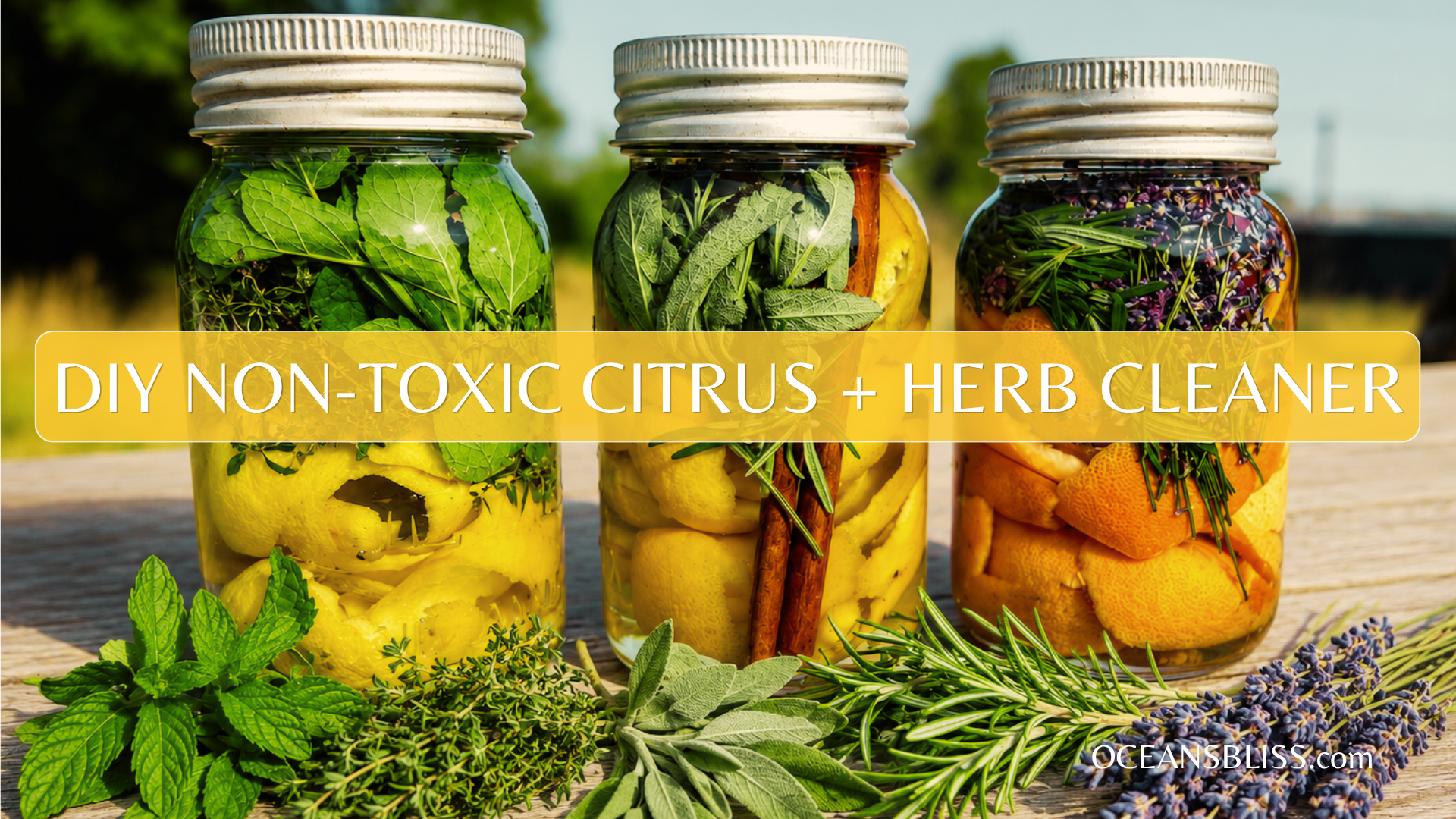
Three simple ways to bring the garden into your non-toxic cleaning routine! One of my favourite parts of seasonal living is finding another use for something that would normally be thrown away.
Citrus peels are a perfect example. Add a handful of herbs from the garden, cover everything in vinegar and suddenly those leftover peels become something useful for the home. And in late summer, I certainly don’t have a shortage of herbs. Mint, thyme, sage, rosemary and lavender are all growing abundantly right now, so I made three different vinegar infusions using herbs from the garden and citrus peels from the kitchen.
It’s a very simple little self-sufficiency habit: use what you have, waste less and slowly replace another store-bought household product.
Why Vinegar Works for Cleaning
White vinegar contains acetic acid, which is what gives it its sour smell and much of its cleaning ability. Its acidity is particularly useful for breaking down mineral deposits, hard-water residue and soap buildup, while also helping with everyday grime and odours. The citrus and herbs make the vinegar smell much nicer and allow us to use ingredients that might otherwise be composted.
One important distinction: I use these as everyday household cleaners, not disinfectants. Vinegar can be useful for cleaning, but it shouldn’t be relied upon when true disinfection is required.
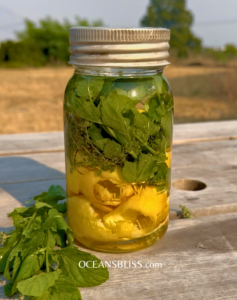
🍋 Lemon + Mint + Thyme
This is probably my favourite everyday combination.
It’s bright, fresh and herbal and smells exactly like something you’d expect a clean kitchen to smell like.
You’ll need:
– Peels from about 2 lemons
– A generous handful of fresh mint
– 4–5 sprigs fresh thyme
– 5% white vinegar
– Clean glass jar with lid
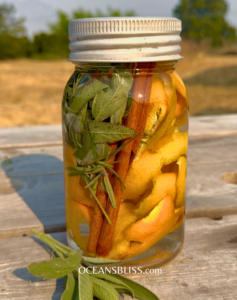
🍊 Orange + Sage + Cinnamon
This one feels like the transition between summer and fall.
Sage is abundant in my garden this time of year, and orange and cinnamon give the vinegar a warmer scent. It’s exactly the kind of seasonal swap I love making as the weather starts changing.
You’ll need:
– Peels from about 2-4 oranges
– 4–6 fresh sage leaves
– 2 cinnamon stick
– several sprigs of rosemary
– 5% white vinegar
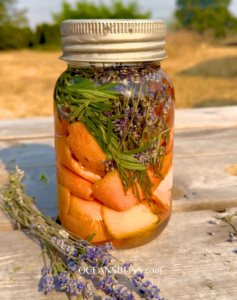
🟠 Grapefruit + Rosemary + Lavender
Grapefruit and rosemary are such a good combination.
The grapefruit keeps this one bright, rosemary makes it wonderfully herbal, and a little lavender softens everything.
You’ll need:
– Peel from 3-4 grapefruit
– 2–3 sprigs fresh rosemary
– About 1 tablespoon dried lavender flowers
– 5% white vinegar
Make the infusion:
Place the lemon peels, mint and thyme into your jar.There’s no need to measure everything perfectly. I usually fill my jar generously with the plant material without packing it down too tightly. Pour white vinegar over everything until the herbs and citrus are completely submerged. Seal and leave in a cool, dark place for about 1–2 weeks, giving it a gentle shake occasionally. Strain well and transfer the finished vinegar into a clean glass bottle or spray bottle.
Where to use it:
This is a good everyday cleaner for many sealed, vinegar-safe surfaces, including sinks, stainless steel, some sealed countertops, shower doors, tubs and other areas with water spots or everyday grime.
Always check the manufacturer’s care instructions and spot-test an inconspicuous area first.

How to Turn the Infusion Into a Cleaning Spray
Once strained, you have a concentrated infused vinegar cleaner.
For tougher mineral deposits and soap residue, I may use the strained vinegar more concentrated.
For ordinary everyday cleaning, start with:
1 part infused vinegar
+
1 part water
Add it to a spray bottle, shake and you’re ready to clean.
Because water has now been introduced, I prefer making smaller batches rather than storing a huge bottle indefinitely.
For greasy kitchen messes, I would use an appropriate soap or detergent rather than expecting vinegar alone to do every cleaning job.
What Vinegar Cleaner Is Particularly Good For
I reach for these sprays for things like:
– Hard-water spots
– Soap residue
– Bathroom sinks and fixtures
– Shower doors
– Stainless-steel sinks
– Everyday grime on vinegar-safe surfaces
– Deodorizing certain washable areas
Vinegar’s acidity is one of the reasons it works particularly well against mineral deposits.
Where NOT to Use Vinegar
Natural doesn’t mean suitable for every surface. Avoid vinegar on natural stone such as marble, limestone and granite, where acid can etch or damage the surface. It’s also best avoided on hardwood, waxed finishes and certain metals and specialty surfaces unless the manufacturer specifically says acidic cleaners are safe.
When in doubt, check the care instructions for the surface first.
And one particularly important rule: Never mix vinegar with chlorine bleach. Vinegar is an acid, and mixing acidic cleaners with bleach can produce dangerous chlorine gas. Health Canada specifically warns against mixing bleach with acids such as vinegar.
What About Adding Alcohol?
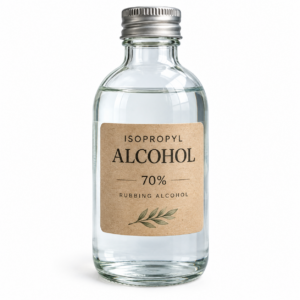
You can add a little isopropyl alcohol to a vinegar-based spray if you’re using it for its solvent properties or quicker evaporation.
For example, for an everyday 500 mL cleaning spray, you could use:
– 225 mL infused vinegar
– 225 mL distilled water
– 50 mL 70% isopropyl alcohol
But there’s an important catch. That small amount of alcohol does not turn the recipe into an alcohol disinfectant. In fact, 50 mL of 70% alcohol in a 500 mL bottle leaves the finished spray at only about 7% alcohol. So I think of this version simply as an alcohol-enhanced cleaning spray, not a disinfecting formula.
If You Actually Need to Disinfect
Cleaning and disinfecting are two different jobs. For everyday dirt, water spots and general cleaning, these infused vinegar sprays are what I reach for.
If there’s a reason I actually need to disinfect a surface, I use a separate appropriate disinfectant according to its label, rather than trying to turn my herbal vinegar into one.
Alcohol can be an effective disinfecting ingredient at appropriate concentrations—CDC describes 60–90% alcohol solutions as having optimum bactericidal activity—but adding vinegar, water and botanical ingredients dilutes that concentration.
Sometimes keeping two simple products for two different purposes makes much more sense than trying to make one bottle do everything.
Using What We Already Have
This is really what these recipes are about for me. The mint is growing outside. The sage needs trimming. Rosemary and thyme are abundant. Lavender has been drying. The citrus peels are already sitting on the cutting board after making breakfast.
Instead of buying another heavily fragranced bottle every time I need a household cleaner, I can look at what’s growing and what’s left over from the kitchen.
That’s the kind of self-sufficiency I love most. It isn’t necessarily about doing everything yourself. It’s about learning to see the resources already around you and asking: What else can I do with this before I throw it away? A few jars of citrus peels, garden herbs and vinegar might seem like a very small thing—but those small habits add up to a home that’s a little more seasonal, a little less wasteful and a lot more connected to what we grow.
DIY Disclaimer: This content is shared for informational, inspirational and educational purposes only.Please use appropriate safety precautions and your own judgment when attempting any project. We are not liable for any injury, damage, or loss resulting from use of this information. This guide reflects the methods I personally use in my own home.


Featured Product
‘Harvest-to-Jar’
Realistic Canning Yields: Fruits & Vegetables
Two-page downloadable guide with bonus content!